
September Market Update: Short-Term Pain, Better Long-Term Potential
September 2026 Market Commentary
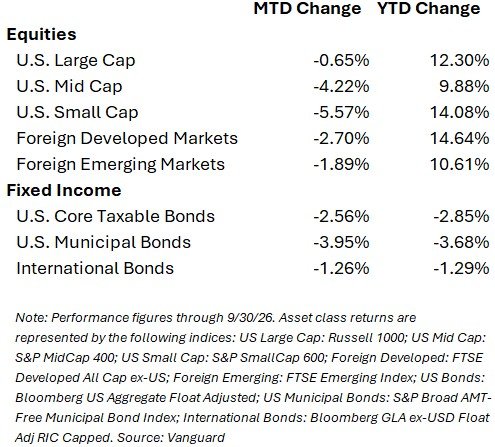
September was a difficult month for investors, with declines across every major asset class in our market snapshot. U.S. large-cap stocks declined 0.65%, while mid- and small-cap stocks fell 4.22% and 5.57%, respectively. International stocks also declined, with developed markets down 2.70% and emerging markets down 1.89%.
Despite September’s weakness, stock returns remain solidly positive for the year. Through the end of September, the major stock markets we track have gained approximately 10% to 15%.
The bigger story during September was the bond market. U.S. core taxable bonds declined 2.56%, municipal bonds fell 3.95%, and international bonds declined 1.26%. Unlike stocks, all three bond categories are now negative for the year.
For investors who own bonds to provide stability and income, these results can understandably be frustrating. But there is an important second part to the story: the same increase in interest rates that caused recent bond losses has also improved the income and longer-term return potential available from bonds today.
Market Snapshot
As of September 30, 2026
Why Bonds Fell So Sharply
Bond prices and interest rates move in opposite directions. When market interest rates rise, existing bonds generally decline in value because newly issued bonds are available at higher yields. The longer the maturity of a bond, generally the more sensitive its price is to changes in interest rates.
That relationship worked against bond investors in September. The 10-year Treasury yield rose more than half a percentage point during the month, ending September at 5.29%. The 30-year Treasury yield finished even higher at 5.68%. These were unusually large moves for the Treasury market and help explain the significant declines experienced by many bond investments.
Several fundamental factors contributed to the increase in yields. Inflation remains above the Federal Reserve’s 2% objective, economic growth has remained resilient, and higher energy prices have added to concerns that inflation could remain elevated. Investors have also become increasingly focused on heavy government borrowing and a growing supply of debt across financial markets, which can put upward pressure on the yields required to attract buyers.
The Federal Reserve added to the pressure when it increased its target interest rate by 0.25 percentage point in September, bringing the federal funds target range to 3.75%–4.00%. The Fed cited solid economic growth, resilient domestic spending, and still-elevated inflation in explaining its decision.
Technical market factors also appear to have amplified the selloff, particularly late in the month. As yields rose, some leveraged investors and other market participants were required to reduce risk or adjust their positions, adding to selling pressure. Hedging activity by some investors with exposure to mortgage-backed securities also contributed to Treasury selling as rising rates increased the interest-rate sensitivity of those portfolios. These trades can create a feedback loop in which rising yields trigger additional selling, which in turn pushes yields still higher.
These trading dynamics help explain the speed of September’s move, but they should not be viewed as the primary reason bonds declined. The underlying pressure initially came from concerns about inflation, interest rates, and government debt. Technical selling then appears to have intensified an already significant move.
The Other Side of Falling Bond Prices
It is easy to look at a negative monthly—or year-to-date—bond return and conclude that bonds have become less attractive. From a longer-term perspective, however, the opposite may be true.
A bond investor’s return comes from two primary sources: the income the bond pays and changes in its market price. Rising interest rates hurt the second component in the short run because existing bond prices decline. But they improve the first component because new bonds can be purchased at higher yields and maturing bonds can be reinvested at those higher rates.
That higher income accumulates over time and can help offset the initial decline in bond prices.
This is why the time horizon matters. An investor who needs to sell an intermediate- or long-term bond shortly after rates rise may experience a loss. An investor who continues holding a diversified bond portfolio, however, continues receiving interest and gradually benefits as the portfolio replaces older, lower-yielding securities with newer bonds offering higher yields.
Starting yields can also provide a useful indication of potential returns from high-quality bonds over longer holding periods. They tell us relatively little about what bonds will return over the next several months, when changes in interest rates can dominate performance. Over longer periods, however, the income generated by bonds becomes an increasingly important component of total return.
In other words, September’s decline in bond prices was painful, but it also improved the longer-term return potential of the asset class.
Higher Yields Change the Investment Landscape
The improvement in yields is particularly important when comparing today’s bond market with the low-rate environment investors experienced for much of the past decade.
When high-quality bonds yielded only 2% or 3%, investors received relatively little income for owning them. With many high-quality bonds now yielding around 5% or more, bonds provide a considerably more meaningful source of portfolio income.
Higher yields also affect the relative attractiveness of stocks. The S&P 500 ended September trading at approximately 19 times expected earnings. That translates to a forward earnings yield of a little over 5%, roughly comparable to the 5.29% yield available on a 10-year U.S. Treasury.
This does not mean stocks and Treasury bonds are interchangeable investments. Stocks offer the potential for earnings growth and long-term capital appreciation, while Treasury bonds provide much greater certainty around their promised payments. But the comparison illustrates how much the investment landscape has changed. When high-quality bonds offered very little income, investors had a greater incentive to accept the additional uncertainty of stocks in pursuit of higher returns. With bond yields now around 5%, investors have a more attractive alternative.
Higher bond yields therefore create a higher hurdle for stock valuations as well. If interest rates remain elevated, investors may be less willing to pay high prices relative to corporate earnings. At the same time, corporate earnings have remained strong, which continues to provide support for stock prices. Rather than providing a clear signal to favor one asset class over another, the changing relationship between stock valuations and bond yields reinforces the benefits of maintaining exposure to both.
A Difficult Month for Diversification
September also provided a reminder that diversification does not guarantee positive returns over short periods.
Stocks declined across U.S. and international markets, while rising interest rates simultaneously pushed bond prices lower. When stocks and bonds decline at the same time, diversified portfolios can experience periods when there are few places to hide. That can make diversification feel less effective precisely when investors would most like it to provide protection.
But diversification is not designed to ensure that something in a portfolio is always rising. Its purpose is to reduce dependence on any single investment, market, or economic outcome over time.
The year-to-date results help illustrate this point. Despite September’s declines, U.S. large-cap stocks have gained 12.30% this year, U.S. mid-cap stocks 9.88%, U.S. small-cap stocks 14.08%, developed international markets 14.64%, and emerging markets 10.61%. September therefore represented a setback within what has otherwise been a strong year for stocks.
Bonds have had a more difficult year, with U.S. core bonds down 2.85%, municipal bonds down 3.68%, and international bonds down 1.29% through September. While disappointing, those declines have occurred alongside the significant improvement in yields discussed above.
What to Watch
Interest rates will likely remain an important driver of markets in the months ahead.
The Federal Reserve will continue evaluating inflation, employment, and economic growth as it determines whether additional changes to short-term interest rates are necessary. Longer-term rates will also respond to factors outside the Fed’s direct control, including inflation expectations, economic growth, federal borrowing needs, and investor demand for Treasury securities.
Technical factors could also contribute to additional short-term volatility. If rates move sharply higher, leveraged investors and other market participants may need to further adjust their positions. Conversely, higher yields may eventually attract additional buyers and help stabilize the bond market.
Exactly where interest rates go next is difficult to predict, which is one reason we do not build portfolios around short-term forecasts.
Final Thoughts—Short Term Pain, Better Long-Term Potential
September was a challenging month because both stocks and bonds declined. But short-term performance and forward-looking return potential are not the same thing. Higher bond yields have created a more attractive starting point for longer-term investors, even if additional volatility remains possible.
Overture’s investment philosophy remains centered on globally diversified portfolios, minimizing investment costs, tax-efficient portfolio management, and comprehensive financial planning. Periodically rebalancing portfolios allows us to manage risk and respond to changing market conditions without requiring us to predict exactly where interest rates or stock prices will move next.
Difficult months are an unavoidable part of investing. The goal is not to construct a portfolio that never declines, but one that can withstand periods like September while remaining positioned to support each investor’s long-term financial plan.
DISCLOSURE
Overture Wealth Management LLC (OWM) is a registered investment advisor offering advisory services in the Commonwealth of Pennsylvania and in other jurisdictions where exempted. Registration does not imply a certain level of skill or training.
This communication is for informational purposes only and is not intended as tax, accounting or legal advice, as an offer or solicitation of an offer to buy or sell, or as an endorsement of any company, security, fund, or other securities or non-securities offering. This communication should not be relied upon as the sole factor in an investment making decision.
Past performance is no indication of future results. Investment in securities involves significant risk and has the potential for partial or complete loss of funds invested. It should not be assumed that any recommendations made will be profitable or equal the performance noted in this publication.
The information herein is provided “AS IS” and without warranties of any kind either express or implied. To the fullest extent permissible pursuant to applicable laws, Overture Wealth Management LLC (referred to as “OWM”) disclaims all warranties, express or implied, including, but not limited to, implied warranties of merchantability, non-infringement, and suitability for a particular purpose.
All opinions and estimates constitute OWM’s judgement as of the date of this communication and are subject to change without notice. OWM does not warrant that the information will be free from error. The information should not be relied upon for purposes of transacting securities or other investments. Your use of the information is at your sole risk. Under no circumstances shall OWM be liable for any direct, indirect, special or consequential damages that result from the use of, or the inability to use, the information provided herein, even if OWM or a OWM authorized representative has been advised of the possibility of such damages. Information contained herein should not be considered a solicitation to buy, an offer to sell, or a recommendation of any security in any jurisdiction where such offer, solicitation, or recommendation would be unlawful or unauthorized.