
October Market Update: A Rebound in Bonds and a Shift in Stock Market Leadership
OCtober 2026 Market Commentary
October brought a reversal of some of September’s market trends. Bonds recovered much of their previous month’s losses as interest rates declined, while U.S. stock performance became increasingly divided. Large-cap stocks declined modestly, but smaller U.S. companies posted gains. International stocks struggled, particularly in emerging markets.
Perhaps the most notable development was the shift in stock market leadership. Technology stocks, which have driven much of the market’s gains in recent years, experienced significant declines, while value-oriented companies and other sectors performed considerably better.
Market Snapshot
As of October 31, 2026
Bonds Recover After September’s Selloff
One of October’s most significant developments was the recovery in the bond market.
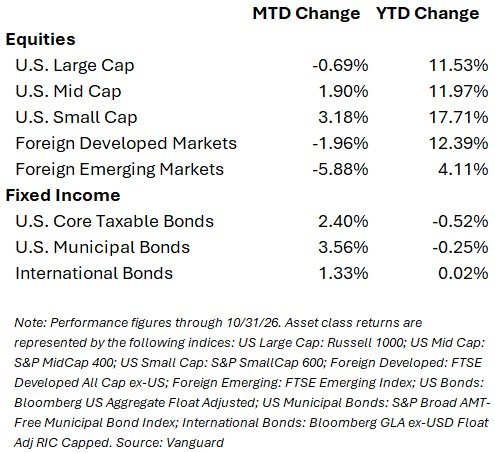
After September’s sharp losses, U.S. core taxable bonds gained 2.40% in October, municipal bonds advanced 3.56%, and international bonds returned 1.33%.
The primary driver was a decline in market interest rates. The 10-year U.S. Treasury yield fell from 5.29% at the end of September to 4.94% at the end of October, a decrease of approximately 0.35 percentage points.
As discussed in last month’s commentary, bond prices and interest rates generally move in opposite directions. Rising yields caused substantial bond price declines in September, while October’s falling yields produced the opposite effect.
Demand for relatively safer investments, including U.S. Treasuries, increased as technology stocks experienced selling pressure. Changing expectations for economic growth and future interest rates also influenced bond prices.
Although October’s gains were encouraging, most major bond categories remain slightly negative for the year. Nevertheless, today’s higher yields provide a more meaningful source of income than investors received during much of the previous decade, even if bond prices experience additional volatility.
A Shift in Market Leadership
October’s U.S. stock market performance revealed a significant difference between the largest technology companies and the broader market.
U.S. large-cap stocks declined 0.69%, while mid-cap stocks gained 1.90% and small-cap stocks advanced 3.18%. However, these broad returns mask an even more dramatic divergence.
The S&P 500 Information Technology Sector Index declined approximately 6.8% during October. More broadly, the Russell 1000 Growth Index, which includes many of the largest technology-oriented companies, fell approximately 6.1%.
In contrast, the Russell 1000 Value Index, which tracks larger U.S. companies generally trading at lower valuations, gained approximately 4.4%. That represents a performance difference of approximately 10.5 percentage points between large-cap growth and value stocks in a single month.
The divergence was also evident within the S&P 500 itself. While the traditional, market-capitalization-weighted index declined, the S&P 500 Equal Weight Index gained approximately 5.0%. This indicates that companies outside the index’s largest holdings generally performed considerably better than the mega-cap companies dominating the traditional index.
Nine of the S&P 500’s eleven sectors posted gains during October. Energy, consumer staples, utilities, and healthcare were among the strongest performers, while weakness was concentrated primarily in technology and communication services.
Much of the selling pressure centered on technology companies associated with artificial intelligence. Investors have become increasingly focused on the enormous amounts being invested in AI infrastructure and whether those investments will ultimately generate sufficient earnings to justify current valuations.
Can Technology’s Extraordinary Returns Continue?
October’s decline provides an opportunity to consider technology’s remarkable performance over a much longer period.
Over the ten years ending October 2026, the S&P 500 Information Technology Sector generated an annualized total return of approximately 25%, including reinvested dividends. For perspective, the broad U.S. stock market has historically delivered annualized returns closer to 10% over very long periods.
The difference is substantial. At a 25% annual return, an investment would grow more than ninefold over ten years. At 10% annually, the same investment would grow to approximately 2.6 times its original value.
Technology’s exceptional performance has been supported by substantial earnings growth, improved profitability, and the expansion of major technology platforms. More recently, enthusiasm surrounding artificial intelligence has provided another powerful source of investor optimism.
However, strong business performance and strong investment returns are not necessarily the same thing.
A stock’s return depends not only on how much a company’s earnings grow, but also on how much investors are willing to pay for those earnings. When valuations rise substantially, future returns become increasingly dependent on companies continuing to meet exceptionally high expectations.
History offers examples of industries and investment styles experiencing prolonged periods of exceptional performance, followed by extended periods of more modest returns or relative underperformance. This does not necessarily require the underlying businesses to deteriorate. Even continued earnings growth may not be enough to support previous stock market returns if valuations decline.
This does not mean technology stocks are destined to underperform over the next decade. Their earnings may continue growing faster than those of the broader market. Nevertheless, assuming that any sector can consistently generate annual returns of 20%–25% indefinitely would be an aggressive expectation.
October’s performance offers a reminder that investor expectations can change quickly, particularly when valuations already reflect considerable optimism about future growth.
Other Market Developments
International stocks experienced a difficult October. Developed international markets declined 1.96%, while emerging markets fell 5.88%, affected in part by weakness in technology-oriented Asian markets and a modest strengthening of the U.S. dollar.
Despite October’s declines, developed international markets remain up 12.39% for the year, slightly ahead of U.S. large-cap stocks. Emerging markets have gained 4.11%.
The Federal Reserve also remained in focus. Following its quarter-percentage-point interest rate increase in September, the Fed left its target interest rate unchanged at 3.75%–4.00% during its October meeting.
Economic activity and consumer spending have remained resilient, while inflation continues to exceed the Fed’s 2% objective. Two Federal Reserve policymakers favored another rate increase, illustrating the continued concern about inflation.
Interestingly, longer-term Treasury yields declined significantly despite the Fed leaving short-term rates unchanged. This highlights how longer-term interest rates respond to factors beyond Federal Reserve policy, including inflation expectations, economic growth, and investor demand for bonds.
Final Thoughts—Looking Beyond the Headlines
October’s market performance illustrates why broad market indexes do not always tell the full story.
At first glance, a decline in U.S. large-cap stocks might suggest that investors had a difficult month. Yet smaller companies, value stocks, and most sectors of the S&P 500 posted gains. The weakness was concentrated primarily among a relatively small group of large technology companies.
This divergence is noteworthy given the extraordinary returns technology stocks have generated over the past decade. Their success has been supported by genuine innovation and substantial earnings growth, but elevated valuations also create more demanding expectations for future performance.
Whether October represents the beginning of a sustained shift in market leadership remains to be seen. Technology stocks could resume their leadership, or other areas of the market could continue gaining ground.
As we approach year-end, an important question is whether the next phase of the market’s advance will continue to depend heavily on a handful of exceptionally large technology companies, or whether gains will become more evenly distributed across the broader market.
DISCLOSURE
Overture Wealth Management LLC (OWM) is a registered investment advisor offering advisory services in the Commonwealth of Pennsylvania and in other jurisdictions where exempted. Registration does not imply a certain level of skill or training.
This communication is for informational purposes only and is not intended as tax, accounting or legal advice, as an offer or solicitation of an offer to buy or sell, or as an endorsement of any company, security, fund, or other securities or non-securities offering. This communication should not be relied upon as the sole factor in an investment making decision.
Past performance is no indication of future results. Investment in securities involves significant risk and has the potential for partial or complete loss of funds invested. It should not be assumed that any recommendations made will be profitable or equal the performance noted in this publication.
The information herein is provided “AS IS” and without warranties of any kind either express or implied. To the fullest extent permissible pursuant to applicable laws, Overture Wealth Management LLC (referred to as “OWM”) disclaims all warranties, express or implied, including, but not limited to, implied warranties of merchantability, non-infringement, and suitability for a particular purpose.
All opinions and estimates constitute OWM’s judgement as of the date of this communication and are subject to change without notice. OWM does not warrant that the information will be free from error. The information should not be relied upon for purposes of transacting securities or other investments. Your use of the information is at your sole risk. Under no circumstances shall OWM be liable for any direct, indirect, special or consequential damages that result from the use of, or the inability to use, the information provided herein, even if OWM or a OWM authorized representative has been advised of the possibility of such damages. Information contained herein should not be considered a solicitation to buy, an offer to sell, or a recommendation of any security in any jurisdiction where such offer, solicitation, or recommendation would be unlawful or unauthorized.