
January 2026 Market & Economic Recap
January Recap
January 2026 presented markets with a reminder that transitions are rarely linear. After finishing 2025 with three consecutive years of double-digit gains, equities entered the new year facing a mix of uncertainty and recalibration. The month was marked by continued positive momentum driven by expectations for continued economic resilience and corporate earnings growth, supported by broadening market participation beyond the narrow leadership that had characterized much of the prior years.
The Federal Reserve held rates steady at its January 28-29 meeting, maintaining the federal funds rate in the 3.5%-3.75% range following three cuts in 2025. Fed Chair Jerome Powell characterized the economy as being on “firm footing” and indicated that policy is no longer significantly restrictive, suggesting the central bank is comfortable pausing while it monitors incoming data. Markets interpreted this as validation that the easing cycle has reached a more measured phase, with rate cuts likely on hold until at least mid-year.
Perhaps the most dramatic market event of the month occurred in the final days of January, when precious metals experienced historic volatility. Gold, which had reached an all-time high above $5,600 per ounce on January 29, fell roughly 9% on January 30. Silver experienced even more extreme moves, plunging as much as 31% in a single session—its worst day since 1980. While unsettling, the corrections appeared technical in nature rather than reflecting fundamental changes to the broader economic or market backdrop, and equities demonstrated resilience by absorbing the commodity market volatility without significant disruption.
Economic Indicators & Labor Market Trends
The economic backdrop in January reflected a continued gradual cooling rather than abrupt slowdown. Labor market data showed job growth remains positive but modest, with the unemployment rate stabilizing near 4.4%—historically low but elevated from recent lows. Wage growth has continued to moderate, easing one source of inflation pressure while still supporting consumer purchasing power.
Consumer spending remained resilient into the start of the year, supported by solid household balance sheets and a strong stock market in 2025. However, sentiment surveys showed consumers remain cautious about the economic outlook, focused on persistent price levels even as the pace of inflation has slowed.
Inflation data released in January showed consumer prices rising 0.3% month-over-month in December, bringing the year-over-year figure to 2.7%—unchanged from November. Core inflation, which excludes volatile food and energy prices, remained at 2.6% year-over-year, the lowest level since 2021. While still above the Fed’s 2% target, the stable readings reinforced the central bank’s patient stance and suggested inflation continues on a gradual downward trajectory without showing signs of reacceleration.
Overall, the January data suggest an economy that continues to expand at a moderate pace, consistent with the “soft landing” scenario that has underpinned much of the recent market strength.
Market Snapshot (through January 31, 2026)
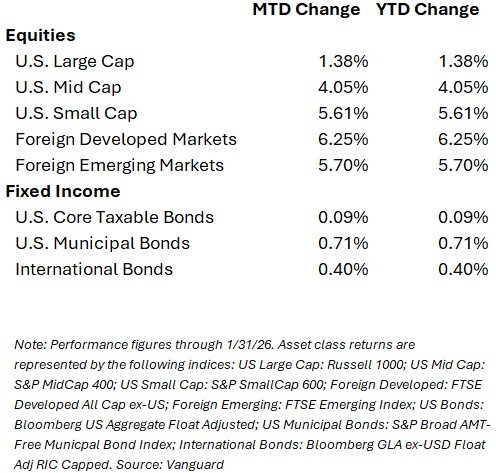
Market Performance & Economic Backdrop
Equities
U.S. equity markets delivered generally positive results in January, with notably improved market breadth. Broader market indices gained modestly for the month, with the equal-weighted S&P 500 outperforming its cap-weighted counterpart—an encouraging sign of broadening market participation beyond the mega-cap technology names that dominated returns in recent years.
Small-cap stocks recovered from December weakness, and value-oriented segments outperformed growth, contributing to healthier market dynamics. Unlike the narrow leadership concentrated in a handful of stocks that characterized much of 2024 and early 2025, January saw more diversified performance across sectors and market capitalizations. This rotation suggested investors were increasingly focused on earnings fundamentals rather than simply bidding up the largest technology names.
The technology sector remained a meaningful contributor to overall market performance, though investors showed more discernment among AI-related companies. After years of indiscriminate buying across the AI ecosystem, January reflected a maturing view that massive spending alone might not guarantee future profits, leading to differentiation between proven winners and more speculative names.
International developed markets posted solid gains in January, while emerging markets showed resilience despite ongoing concerns about China’s economic trajectory. Currency movements and divergent central bank policies continued to create opportunities in global markets.
The January performance reinforced a theme that many strategists highlighted heading into 2026: after years of narrow leadership concentrated in mega-cap technology stocks, market returns are likely to become more broadly distributed as investors focus increasingly on earnings growth rather than multiple expansion.
Fixed Income
Bond markets delivered modest positive returns in January as Treasury yields remained relatively range-bound. The 10-year Treasury yield fluctuated between 4.2% and 4.5% during the month, settling near the middle of that range. Shorter-maturity yields declined slightly as markets adjusted expectations for the pace of Fed rate cuts, while longer-term yields reflected ongoing attention to growth expectations and fiscal dynamics.
High-quality investment-grade bonds benefited from stable spreads and consistent income generation. Municipal bonds outperformed Treasuries on a total return basis, with yields declining more significantly across the curve as investors showed strong demand for tax-advantaged income.
The fixed income environment in January reinforced the renewed attractiveness of bonds as a core portfolio holding. With yields still elevated by historical standards and inflation showing continued progress toward target, bonds are positioned to provide meaningful income and diversification benefits—a marked change from much of the prior decade.
Precious Metals
January proved to be a dramatic month for precious metals, continuing 2025’s historic rally while serving as a stark reminder of the asset class’s inherent volatility. After posting extraordinary gains in 2025—with gold advancing approximately 65% and silver surging roughly 150%—both metals extended their momentum into the new year before experiencing sharp corrections late in the month.
Gold reached an all-time high above $5,600 per ounce on January 29, extending 2025’s best performance since 1979. However, news regarding President Trump’s nomination of Kevin Warsh as the next Federal Reserve Chair triggered profit-taking, with gold falling roughly 9% on January 30 in its sharpest single-day decline in over 40 years. Silver experienced even more pronounced volatility—after briefly touching $120 per ounce, it declined as much as 31% in a single session on January 30-31–its worst day since 1980.
Silver experienced even more pronounced volatility, characteristic of its dual role as both a precious metal and an industrial commodity. After briefly touching $120 per ounce, silver declined sharply on January 30-31, falling as much as 31% in a single session—its worst day since 1980. The correction was amplified by increased margin requirements from commodity exchanges and month-end positioning dynamics. Despite the volatility, silver remained significantly higher than year-ago levels.
While precious metals can serve a purpose in diversified portfolios—as inflation hedges, diversifiers, and stores of value during periods of monetary uncertainty, January’s volatility underscored that these potential benefits come with the possibility of sharp, short-term price swings. Those considering exposure should do so with appropriate position sizing and long-term time horizons.
Global Economic Backdrop
Globally, central banks continued to move at different speeds in their policy trajectories. The Bank of England and European Central Bank maintained their own easing paths, though inflation persistence in services sectors kept policy decisions data-dependent. In Asia, divergent economic conditions led to varied policy approaches, with some central banks on hold and others continuing gradual adjustments.
China’s economic data remained mixed, with policy support measures providing some stabilization but structural challenges persisting. Growth concerns and property sector headwinds continued to weigh on sentiment, though Chinese equity markets showed resilience early in the year.
Looking Ahead: February 2026 and Beyond
As we move into February and the remainder of the year, several themes are coming into sharper focus.
The broadening theme is gaining momentum. January’s market performance—with equal-weighted indices outperforming, small caps recovering, and value stocks showing strength—suggests that the narrow leadership of recent years may indeed be giving way to more balanced participation. This is healthy for the sustainability of the bull market and creates opportunities across a wider range of stocks and sectors.
AI investment continues to mature. While artificial intelligence remains a transformational theme, January reflected a more discerning approach from investors. Rather than indiscriminately rewarding all AI-related companies, markets are beginning to differentiate between those with proven business models and sustainable competitive advantages versus those making speculative bets. This more selective approach is a healthy development that should lead to more rational capital allocation over time.
The Fed’s pause is appropriate but policy remains supportive. With rates no longer in restrictive territory and the Fed positioned to cut further if economic conditions warrant, monetary policy has shifted from headwind to neutral-to-tailwind. This should continue to provide a supportive backdrop for both equities and fixed income, even if the pace of easing is slower than some initially anticipated.
Earnings growth becomes the key driver. With valuations elevated in many segments and multiple expansion unlikely to drive returns as it did in recent years, the focus shifts to fundamental earnings growth. Fourth quarter earnings season is underway, and early results have been generally solid. For 2026, consensus expectations call for mid-to-high single-digit earnings growth for the S&P 500, with the potential for stronger growth outside the mega-cap technology segment.
Fixed income deserves renewed attention. The reset in bond yields over the past few years has restored the income and diversification benefits that many investors missed during the low-rate environment. For those building portfolios for the long term—particularly those focused on income, stability, or approaching retirement—bonds warrant a more meaningful allocation than they have in recent years.
Volatility is a feature, not a bug. January’s price action served as a useful reminder that markets rarely move in straight lines, even during bull markets. Episodes of volatility—whether driven by AI developments, Fed communications, economic data, or geopolitical events—are normal and should be expected. What matters is maintaining discipline, staying aligned with long-term goals, and avoiding reactive decisions based on short-term headlines.
Diversification remains the foundation. In an environment where leadership is rotating, policy paths are diverging globally, and uncertainty remains elevated, well-diversified portfolios are positioned to capture opportunities across asset classes and geographies while managing downside risk. After strong performance in 2025, disciplined rebalancing ensures portfolios remain aligned with target allocations and risk tolerances.
As we continue through the early months of 2026, the investment landscape appears constructive for patient, diversified investors. Economic growth continues at a moderate pace, inflation is trending in the right direction, monetary policy is supportive, and both equities and bonds offer reasonable return prospects. While the path forward will include volatility and uncertainty—as it always does—these fundamentals provide a solid foundation for long-term investors focused on their financial goals rather than short-term market noise.
DISCLOSURE
Overture Wealth Management LLC (OWM) is a registered investment advisor offering advisory services in the Commonwealth of Pennsylvania and in other jurisdictions where exempted. Registration does not imply a certain level of skill or training.
This communication is for informational purposes only and is not intended as tax, accounting or legal advice, as an offer or solicitation of an offer to buy or sell, or as an endorsement of any company, security, fund, or other securities or non-securities offering. This communication should not be relied upon as the sole factor in an investment making decision.
Past performance is no indication of future results. Investment in securities involves significant risk and has the potential for partial or complete loss of funds invested. It should not be assumed that any recommendations made will be profitable or equal the performance noted in this publication.
The information herein is provided “AS IS” and without warranties of any kind either express or implied. To the fullest extent permissible pursuant to applicable laws, Overture Wealth Management LLC (referred to as “OWM”) disclaims all warranties, express or implied, including, but not limited to, implied warranties of merchantability, non-infringement, and suitability for a particular purpose.
All opinions and estimates constitute OWM’s judgement as of the date of this communication and are subject to change without notice. OWM does not warrant that the information will be free from error. The information should not be relied upon for purposes of transacting securities or other investments. Your use of the information is at your sole risk. Under no circumstances shall OWM be liable for any direct, indirect, special or consequential damages that result from the use of, or the inability to use, the information provided herein, even if OWM or a OWM authorized representative has been advised of the possibility of such damages. Information contained herein should not be considered a solicitation to buy, an offer to sell, or a recommendation of any security in any jurisdiction where such offer, solicitation, or recommendation would be unlawful or unauthorized.

