
February 2026 Market & Economic Recap
February Recap
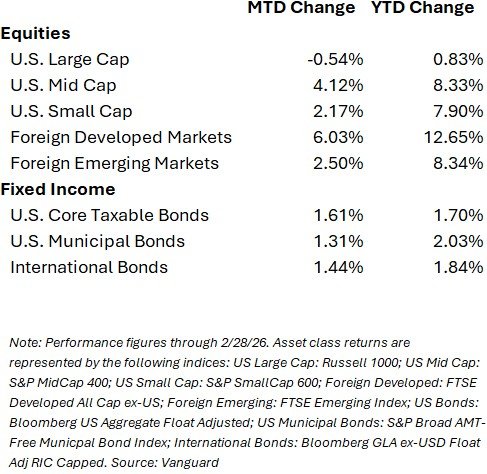
After a strong start to the year, U.S. equities in aggregate paused in February. Major indexes were largely flat, with technology stocks lagging while value-oriented sectors and smaller companies performed well. International equities delivered solid gains, highlighting the benefits of global diversification. However, much of the progress achieved in February was erased in early March due to heightened geopolitical tensions involving Iran.
Fixed income contributed positively as Treasury yields declined modestly, supporting bonds and balanced portfolios. The yield on the 10 Year Treasury finished just below 4%. The market environment reinforces the importance of diversification across both asset classes and sectors.
Economic data in February remained mixed but generally constructive. Consumer spending and labor market trends continue to support growth, while business activity indicators showed modest slowing—consistent with a gradual economic deceleration rather than an abrupt contraction. Inflation concerns remain elevated, particularly given the recent surge in energy prices resulting from the conflict in Iran.
Inflation and Interest Rates Still in Focus
Inflation remains a key driver of Federal Reserve policy. Although price pressures have eased from their peak, the pace of improvement has slowed. As a result, markets now anticipate a slower and more measured pace of rate reductions in 2026, reflecting a “higher-for-longer” interest rate environment. The last 12-month inflation reading (CPI-U) came in at 2.4% in mid-February.
Escalating Conflict in the Middle East and Energy Markets
Late February saw a significant escalation in geopolitical tensions as the U.S. and Israel engaged Iranian targets, prompting retaliatory missile and drone strikes from Iran on U.S. and allied facilities.
The market response was swift. Oil prices surged amid concerns over potential supply disruptions, particularly in the Strait of Hormuz, a key route for roughly one-fifth of global oil shipments. Brent crude traded above $119 per barrel in early March, with WTI near similar levels. Elevated energy costs could feed into inflation pressures and influence the Federal Reserve’s policy decisions. (reuters.com)
Financial markets have reacted with increased volatility, especially in energy-sensitive sectors. While geopolitical events can trigger short-term market swings, history shows that markets tend to stabilize as investors refocus on economic fundamentals.
Market Snapshot (through February, 2026)
Market Volatility and Early March Moves
Equity markets have experienced heightened volatility in early March. Rising oil prices and geopolitical uncertainty led to sharp daily swings, erasing much of the gains built during February and leaving portfolios closer to neutral for the year so far.
This pullback reflects investor caution in response to elevated risks, rather than a deterioration of underlying economic fundamentals. Short-term drawdowns are normal, and investors with well-diversified portfolios generally benefit from staying the course.
Periods like this also highlight the importance of maintaining sufficient liquidity for short-term needs. For investors nearing or in retirement, having 12–24 months of planned portfolio withdrawals in secure, liquid cash equivalents can provide peace of mind and reduce the need to sell assets during periods of market volatility.
Looking Ahead
Key themes likely to shape markets in March include Geopolitical Risk and Energy Prices: the Iran conflict will continue to influence energy markets. Prolonged supply concerns could feed into higher inflation and affect economic growth expectations.
- Inflation and Federal Reserve Policy: Elevated energy costs may slow progress toward inflation targets, potentially delaying or moderating rate cuts.
- Economic Growth and Corporate Earnings: Overall economic indicators remain generally positive, but sectors sensitive to rates or energy costs warrant attention.
- Market Volatility: Investors should expect swings as markets balance geopolitical risk with underlying fundamentals. Short-term declines are a normal part of market cycles.
DISCLOSURE
Overture Wealth Management LLC (OWM) is a registered investment advisor offering advisory services in the Commonwealth of Pennsylvania and in other jurisdictions where exempted. Registration does not imply a certain level of skill or training.
This communication is for informational purposes only and is not intended as tax, accounting or legal advice, as an offer or solicitation of an offer to buy or sell, or as an endorsement of any company, security, fund, or other securities or non-securities offering. This communication should not be relied upon as the sole factor in an investment making decision.
Past performance is no indication of future results. Investment in securities involves significant risk and has the potential for partial or complete loss of funds invested. It should not be assumed that any recommendations made will be profitable or equal the performance noted in this publication.
The information herein is provided “AS IS” and without warranties of any kind either express or implied. To the fullest extent permissible pursuant to applicable laws, Overture Wealth Management LLC (referred to as “OWM”) disclaims all warranties, express or implied, including, but not limited to, implied warranties of merchantability, non-infringement, and suitability for a particular purpose.
All opinions and estimates constitute OWM’s judgement as of the date of this communication and are subject to change without notice. OWM does not warrant that the information will be free from error. The information should not be relied upon for purposes of transacting securities or other investments. Your use of the information is at your sole risk. Under no circumstances shall OWM be liable for any direct, indirect, special or consequential damages that result from the use of, or the inability to use, the information provided herein, even if OWM or a OWM authorized representative has been advised of the possibility of such damages. Information contained herein should not be considered a solicitation to buy, an offer to sell, or a recommendation of any security in any jurisdiction where such offer, solicitation, or recommendation would be unlawful or unauthorized.

