
August Market Update: Earnings, Inflation & Higher Bond Yields
August 2026 Market Commentary
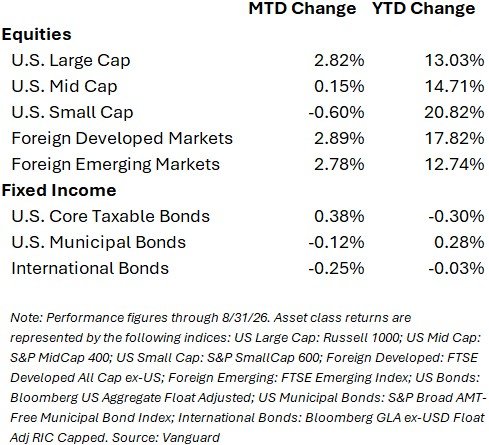
Financial markets generally moved higher in August, with U.S. large-cap and international stocks benefiting from continued economic growth and another strong corporate earnings season. U.S. large-cap stocks gained 2.82% for the month, while developed and emerging international markets gained 2.89% and 2.78%, respectively. Bond returns were mixed, although longer-term Treasury yields remained elevated as investors weighed persistent inflation, increased government borrowing, and the possibility that interest rates may remain higher for longer.
Market Snapshot
As of August 31, 2026
Strong Earnings Continue to Support Stock Prices
Corporate earnings helped support the market during August. Second-quarter results were generally better than expected, with a large majority of reporting S&P 500 companies exceeding analysts’ earnings estimates. Technology companies continued to benefit from substantial spending on artificial intelligence and data-center infrastructure, but profit growth was not limited to the largest technology firms. Energy companies and several other areas of the market also reported healthy earnings growth.
This broader earnings strength is important because stock prices cannot rely indefinitely on investors being willing to pay higher valuations. Over longer periods, sustainable market returns depend largely on companies growing their profits. Although valuations remain elevated in parts of the U.S. market, continued earnings growth has provided meaningful support for stock prices.
CPI Moderated, but Interest-Rate Uncertainty Remains
The inflation report released in August showed additional progress. Consumer prices increased 3.4% over the 12 months ending in July, down slightly from 3.5% the prior month. Core inflation, which excludes food and energy, declined to 2.5% from 2.6%. On a monthly basis, both headline and core inflation were relatively moderate.
Even with this improvement in CPI, inflation remains above the Federal Reserve’s 2% objective. At the annual Jackson Hole symposium, Federal Reserve Chair Kevin Warsh emphasized that recent inflation data had not improved enough to give policymakers confidence that inflation was returning sustainably to target. His comments reinforced the possibility that the Fed may need to keep short-term rates elevated—or potentially raise them further—if inflation does not continue to moderate.
The bond market reflected that uncertainty. The 10-year Treasury yield finished August near 4.75%, while the 30-year yield briefly reached its highest level since 2007. U.S. core taxable bonds nevertheless gained 0.38% during the month, while municipal and international bonds posted modest declines. Longer-term yields are influenced by more than Federal Reserve policy. Investors are also demanding greater compensation for inflation risk, growing federal deficits, and the increased supply of Treasury and corporate debt.
Although higher yields can create short-term pressure on bond prices, they also improve the longer-term return potential of fixed-income investments. This is an important distinction: the roughly flat returns produced by broad bond benchmarks this year do not necessarily mean bonds have become less attractive. In many cases, the opposite is true.
Yields on U.S. investment-grade corporate bonds ended August around 5.5%, with short- and intermediate-term bonds offering yields near or above 5%. These yields are meaningfully higher than those available for much of the past decade and provide investors with a more attractive source of portfolio income without needing to rely exclusively on stocks. Higher-quality bonds can still decline in value when interest rates rise, and corporate bonds carry credit risk, but their higher starting yields provide a larger income cushion against future price volatility.
The wide difference between short- and long-term bond performance also reinforces the value of diversifying across maturities rather than making an all-or-nothing bet on the direction of interest rates. For investors nearing or in retirement, the combination of competitive yields and less interest-rate sensitivity makes short- and intermediate-term bonds particularly useful for funding future spending needs.
What to Watch: The Fed’s September Decision
The Federal Reserve’s next interest-rate decision is scheduled for September 16. Expectations have changed quickly. In a Reuters survey conducted during August, 90% of economists expected the Fed to leave rates unchanged at its September meeting. As of September 2, however, futures-market pricing indicated approximately a 70% probability that the Fed would increase its target rate by 0.25%.
The difference highlights the unusual amount of uncertainty surrounding the decision. Inflation has moderated from its recent peak, but it remains above the Fed’s target. At the same time, the labor market has shown signs of slower hiring. Under normal circumstances, softer employment growth would give the Fed more reason to leave rates unchanged. Renewed increases in oil prices, however, have raised concerns that energy costs could slow—or reverse—recent progress on inflation.
The August employment report and the next inflation readings will therefore carry added importance. Strong job growth or firmer inflation would support the case for an increase, while weaker employment data or further improvement in inflation could allow the Fed to remain on hold. Market-implied probabilities will likely continue to shift as these reports are released.
Whether the Fed raises rates in September is less important to a long-term investor than the broader message: interest rates may remain elevated for some time. That environment creates challenges for rate-sensitive borrowers and can contribute to market volatility. It also creates opportunities for savers and bond investors, who are now being compensated more meaningfully for holding high-quality fixed-income investments.
Diversification Still Matters—even During a Strong Market
August’s equity gains were fairly broad, but they were not uniform. Developed international stocks gained 2.89%, while emerging markets rose 2.78%. U.S. mid-cap stocks posted a more modest gain, and small-cap stocks declined 0.60%. Even with that monthly decline, U.S. small-cap stocks remained the strongest-performing equity category in the market snapshot, gaining 20.82% through the first eight months of the year.
The continued participation of markets outside the largest U.S. companies is encouraging, but it does not eliminate risk. U.S. stock valuations remain above historical averages, inflation has not fully returned to the Fed’s target, and geopolitical tensions continue to affect energy prices. These conditions do not provide a reliable signal about what markets will do next month, but they do support maintaining exposure to multiple sources of return.
A globally diversified portfolio will rarely have every investment leading at the same time. That is not a weakness of diversification; it is how diversification works. Holding U.S. and international stocks, companies of different sizes, and a range of fixed-income investments reduces dependence on any single market outcome.
Final Thoughts—A Strong Year Does Not Change the Plan
Through eight months, 2026 has been a strong year for many investors. Periods of positive performance can make it tempting to increase risk or concentrate more heavily in whichever investments have recently performed best. The same headlines that feel reassuring after markets rise can quickly become reasons for concern when prices decline.
Overture’s investment philosophy remains centered on globally diversified portfolios, minimizing investment costs, tax-efficient portfolio management, and comprehensive financial planning. Periodically rebalancing portfolios allows us to manage risk and take advantage of changing market leadership without attempting to predict short-term market movements.
For households approaching or already in retirement, maintaining an appropriate cash reserve is also an important part of staying invested through periods of volatility. As a general guideline, those with steady employment may consider holding 6 to 12 months of expenses in cash equivalents, while retirees or those preparing for retirement may benefit from keeping 12 to 24 months of planned portfolio withdrawals readily available. The appropriate amount will depend on each household’s income sources, spending needs, and comfort with market fluctuations.
Market conditions will continue to change, but a well-designed financial plan should not depend on correctly forecasting each change. Staying diversified, maintaining adequate liquidity, and following a disciplined rebalancing strategy remain among the most dependable ways to navigate an uncertain investment environment.
DISCLOSURE
Overture Wealth Management LLC (OWM) is a registered investment advisor offering advisory services in the Commonwealth of Pennsylvania and in other jurisdictions where exempted. Registration does not imply a certain level of skill or training.
This communication is for informational purposes only and is not intended as tax, accounting or legal advice, as an offer or solicitation of an offer to buy or sell, or as an endorsement of any company, security, fund, or other securities or non-securities offering. This communication should not be relied upon as the sole factor in an investment making decision.
Past performance is no indication of future results. Investment in securities involves significant risk and has the potential for partial or complete loss of funds invested. It should not be assumed that any recommendations made will be profitable or equal the performance noted in this publication.
The information herein is provided “AS IS” and without warranties of any kind either express or implied. To the fullest extent permissible pursuant to applicable laws, Overture Wealth Management LLC (referred to as “OWM”) disclaims all warranties, express or implied, including, but not limited to, implied warranties of merchantability, non-infringement, and suitability for a particular purpose.
All opinions and estimates constitute OWM’s judgement as of the date of this communication and are subject to change without notice. OWM does not warrant that the information will be free from error. The information should not be relied upon for purposes of transacting securities or other investments. Your use of the information is at your sole risk. Under no circumstances shall OWM be liable for any direct, indirect, special or consequential damages that result from the use of, or the inability to use, the information provided herein, even if OWM or a OWM authorized representative has been advised of the possibility of such damages. Information contained herein should not be considered a solicitation to buy, an offer to sell, or a recommendation of any security in any jurisdiction where such offer, solicitation, or recommendation would be unlawful or unauthorized.