
April 2026 Market Recap: Rebound after March Volatility
April Market Commentary
April marked a sharp rebound for financial markets, as equities surged following a volatile first quarter. While the headlines remained dominated by geopolitical tensions and inflation concerns, markets looked through near-term uncertainty and focused instead on continued economic resilience and improving corporate fundamentals.
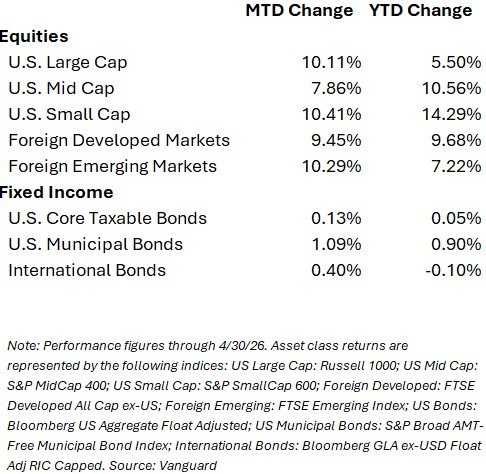
Market Snapshot (through April 30, 2026)
Strong Equity Rebound
After a difficult March, equity markets experienced a broad-based rally that pushed major indices back toward (and in some cases to) new highs by month-end. U.S. markets were supported by solid economic data and continued earnings growth expectations, while international markets benefited from improving sentiment and a weaker U.S. dollar.
Notably, market leadership continued to broaden. Smaller companies and international stocks—areas that had lagged in prior years—outperformed large-cap U.S. stocks on a year-to-date basis. This is a healthy development, as it reflects a more balanced and durable market environment.
Fixed Income: Still Stabilizing
Fixed income markets delivered modestly positive returns in April, with core bonds posting small gains as income continued to offset limited price movement. Treasury yields were volatile throughout the month, as markets recalibrated expectations around inflation and the timing of Federal Reserve rate cuts. The 10-year Treasury yield remained elevated, reflecting persistent inflation pressures alongside signs of moderating, but still resilient, economic growth.
Within fixed income, credit sectors outperformed. Investment-grade and high-yield corporate bonds benefited from stable economic conditions and continued investor demand for income, leading to modest spread tightening. In contrast, longer-duration, interest rate–sensitive sectors such as Treasuries were more constrained, as higher yields and shifting rate expectations limited price appreciation. Treasury Inflation-Protected Securities (TIPS), particularly at the short end of the curve, remained a steady contributor—helping preserve purchasing power while experiencing less price volatility than longer-duration bonds.
Overall, April reinforced a theme that has been in place for much of the year:
- Income remains the primary driver of fixed income returns, not price appreciation
- Volatility in interest rates persists, even as markets await clearer direction from inflation data and the Fed
- Credit sectors continue to provide incremental return opportunities, supported by solid fundamentals.
Looking ahead, bond market performance will likely continue to hinge on the interplay between inflation trends, Fed policy expectations, and geopolitical developments. While current yields remain attractive from an income standpoint, the path for capital appreciation will depend on whether inflation shows a more sustained move lower.
Economic Backdrop: Resilient but Uneven
The U.S. economy continued to grow at a moderate pace, with first-quarter GDP expanding at approximately 2%. However, the data beneath the surface remains mixed.
- Inflation remains elevated, with headline inflation around 3.5%
- Consumer spending has begun to show signs of strain, with real spending growth slowing to its weakest pace since the 2020 pandemic.
- Business investment—particularly in AI and infrastructure—has been a key driver of growth
At the same time, consumer confidence has weakened, reflecting concerns about rising prices and economic uncertainty.
Federal Reserve: Waiting for Clarity
The Federal Reserve held interest rates steady during its late April meeting, maintaining a target range of 3.50%–3.75%. The Fed continues to balance two competing forces:
- Inflation remains above target, driven in part by higher energy prices
- Economic momentum appears to be moderating
For now, policymakers are taking a “wait and see” approach. Markets are increasingly aligned with this stance, with expectations shifting toward a slower and more measured path for potential rate cuts.
Geopolitics and Energy Volatility
Geopolitical tensions—particularly in the Middle East—played a significant role in April’s market narrative. Oil prices briefly surged above $100 per barrel amid supply disruptions and uncertainty surrounding the Strait of Hormuz.
These dynamics contributed to renewed inflation pressures and increased market volatility early in the month. However, as the month progressed, some of these fears eased, helping support the strong equity rebound into month-end.
Final Thoughts
Following the sharp equity declines in March, it would have been understandable for investors to feel uneasy or consider reducing market exposure. However, the swift rebound in April serves as a reminder that, for long-term investors with a disciplined investment approach, staying the course is often the most effective strategy.
Short-term market movements—whether driven by geopolitical events or economic data—are inherently unpredictable. Rather than reacting to these fluctuations, maintaining a well-diversified portfolio aligned with long-term goals remains the most reliable way to navigate periods of uncertainty.
As always, we will continue to monitor developments closely and make adjustments when warranted—but not in response to short-term noise.
DISCLOSURE
Overture Wealth Management LLC (OWM) is a registered investment advisor offering advisory services in the Commonwealth of Pennsylvania and in other jurisdictions where exempted. Registration does not imply a certain level of skill or training.
This communication is for informational purposes only and is not intended as tax, accounting or legal advice, as an offer or solicitation of an offer to buy or sell, or as an endorsement of any company, security, fund, or other securities or non-securities offering. This communication should not be relied upon as the sole factor in an investment making decision.
Past performance is no indication of future results. Investment in securities involves significant risk and has the potential for partial or complete loss of funds invested. It should not be assumed that any recommendations made will be profitable or equal the performance noted in this publication.
The information herein is provided “AS IS” and without warranties of any kind either express or implied. To the fullest extent permissible pursuant to applicable laws, Overture Wealth Management LLC (referred to as “OWM”) disclaims all warranties, express or implied, including, but not limited to, implied warranties of merchantability, non-infringement, and suitability for a particular purpose.
All opinions and estimates constitute OWM’s judgement as of the date of this communication and are subject to change without notice. OWM does not warrant that the information will be free from error. The information should not be relied upon for purposes of transacting securities or other investments. Your use of the information is at your sole risk. Under no circumstances shall OWM be liable for any direct, indirect, special or consequential damages that result from the use of, or the inability to use, the information provided herein, even if OWM or a OWM authorized representative has been advised of the possibility of such damages. Information contained herein should not be considered a solicitation to buy, an offer to sell, or a recommendation of any security in any jurisdiction where such offer, solicitation, or recommendation would be unlawful or unauthorized.